
Training · learner work
The Score Shows Its Work. The Data Cannot Prove It Yet.
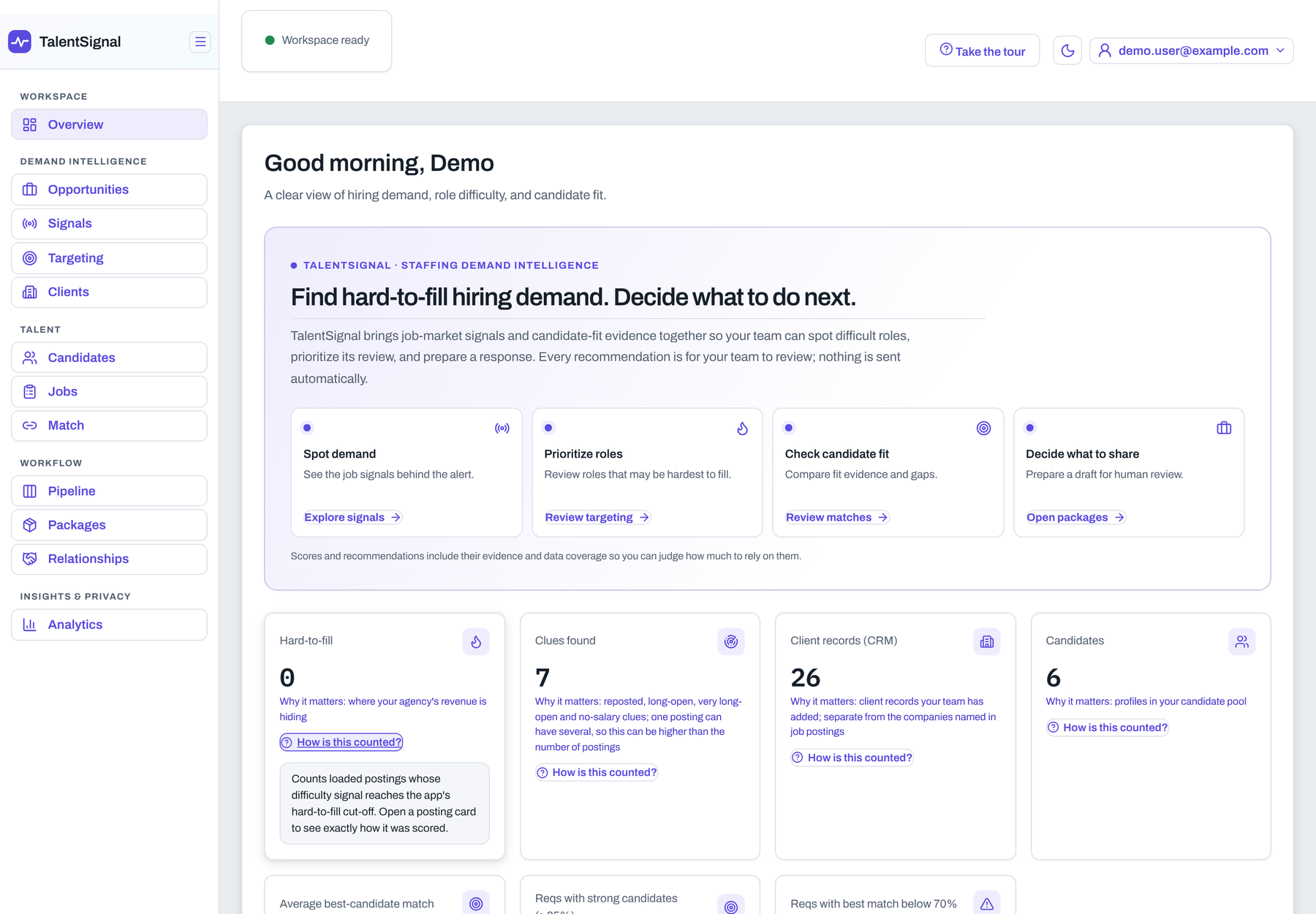
A Colaberry learner built a staffing-intelligence app that ranks open roles by how hard they look to fill, then tested her own score and reported the honest result: not enough data yet. This record follows the decisions she logged along the way and what the repository can and cannot prove.
verified
All student projects- Industry
- Staffing
- Capability
- Explainable demand scoring with human release
- Status
- Not pursued
- Built by
- Megan Dimiyo-Mbenoun
- Published
- 2026-11-19
The situation
Staffing teams usually learn that a role is hard to fill late, after a competitor has already placed someone or the client has gone quiet. The early clues are public: a posting open for months, a role reposted, a listing with no salary range, an employer whose filings show it is hiring. Nobody has time to read thousands of postings and weigh them.
The person who feels this is the sales user at a staffing agency, who has to decide which company to call first. Job boards list the postings but say nothing about which employer is struggling to fill them.
TalentSignal pulls those clues together, ranks which roles look worth a closer look, shows how well available candidates fit, and drafts the outreach. It is a decision aid, not an autopilot: a person releases every draft, and releasing records a decision without sending anything.
The build is honest about how far it got. It runs locally, ingestion is run by hand, real postings come from two companies and sit next to seeded rows, and the hardness score has not yet been shown to predict anything.
What it had to do
- Surface roles that look hard to fill from public evidence, earlier than a staffing team would otherwise hear about them.
- Make every score explainable: the reasons, the weights version and the basis behind it.
- Keep the final say with a person on anything that would leave the platform.
- Say plainly when the data cannot support a conclusion.
What constrained it
- Only public sources: Greenhouse and Lever job boards, with no API key, and public H-1B, federal award and SEC Form D records.
- Nothing leaves the system without a person. A drafted package is released once, by a signed-in user, and releasing sends nothing.
- Every weight and threshold is a business decision, so each one is a decision file, and most are still proposals pending the owner.
- No language model is called. Verdicts, packages and email drafts are fixed templates over computed facts.
- The repository is private, so this record describes the work without exposing its contents.
Decisions that made the difference
Five choices shaped the system. Each one lives at a specific point in the drawing above.
- At Score with versioned weights
The spec gave no weights, so every weight became a proposal
The first scored opportunity needed a confidence score, and nothing in the requirements said what produced it or how much each clue should count.
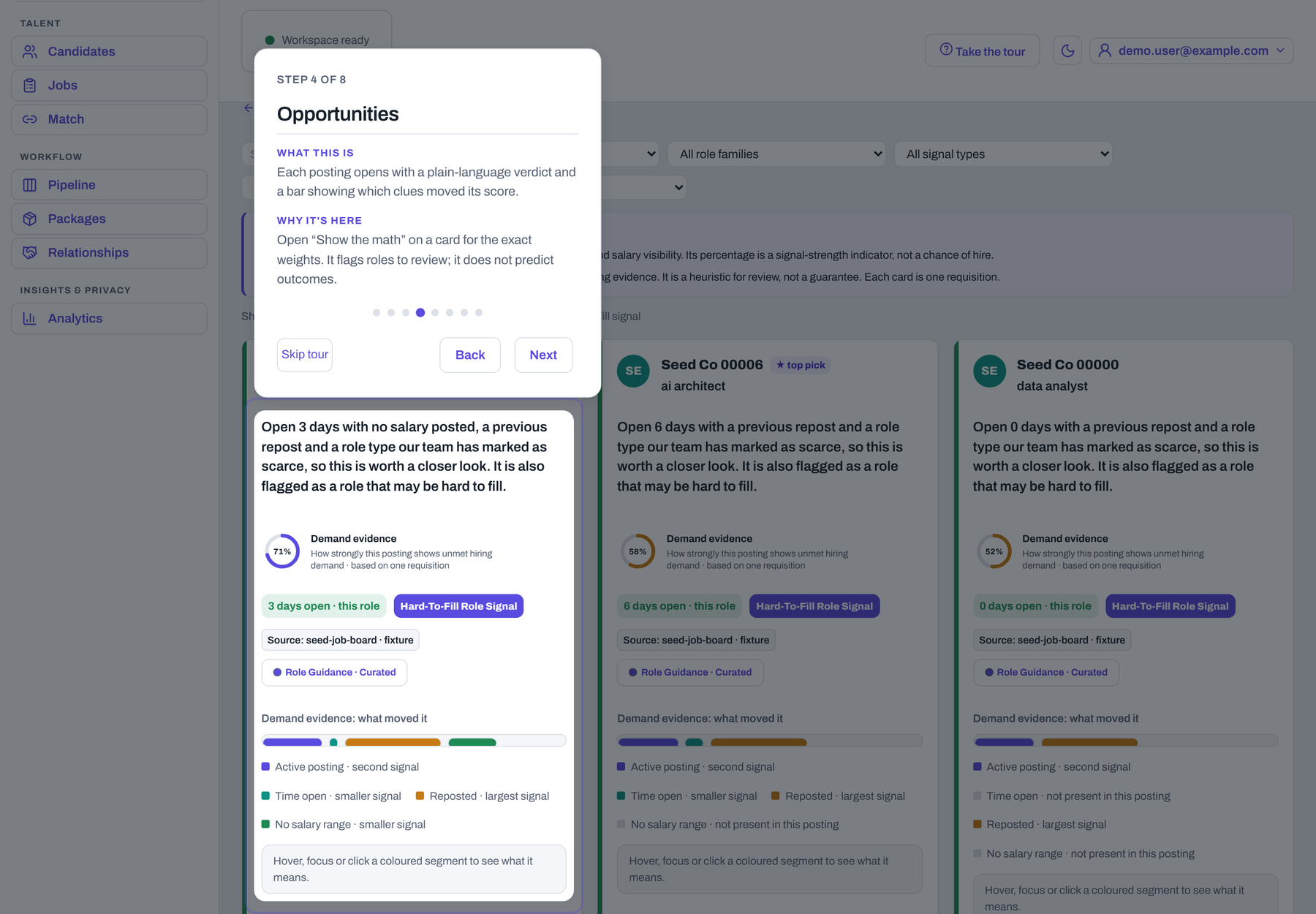
She searched the full build guide to confirm the gap, then put every weight in one config object instead of inline: a 0.20 base, 0.32 for a repost, 0.32 for days open capped at 30, and 0.16 for a missing salary range. The base exists because her first draft scored a real, fresh posting as 0.0, which claims no evidence where a posting is evidence.
Evidence Decision files 007 and 007b, committed 22 and 23 Jul 2026, and the config file the score reads.
24 of 54When the owner answers, changing a weight is a one-line edit. Until then the weights are labeled as her best guess, along with most of the business logic: 24 of 54 decision records still say proposed.
- At Falls back to the keyword list
One job board was left out rather than averaged in
The main hard-to-fill factor fired on a hand-picked keyword list. Measuring how long each role family stays open was the fix, but the two job boards disagreed wildly.
Measure each role family's median days open from Greenhouse only, with at least 10 observations, and keep the keyword list as a named fallback. O*NET occupation codes were rejected as too heavy for about 1,040 titles. Lever's median was 1,169 days against 33 for Greenhouse, most likely a date field read wrongly, so Lever was excluded.
Evidence Decision file 046, committed 8 Sep 2026, with the per-family observation counts from one live run.
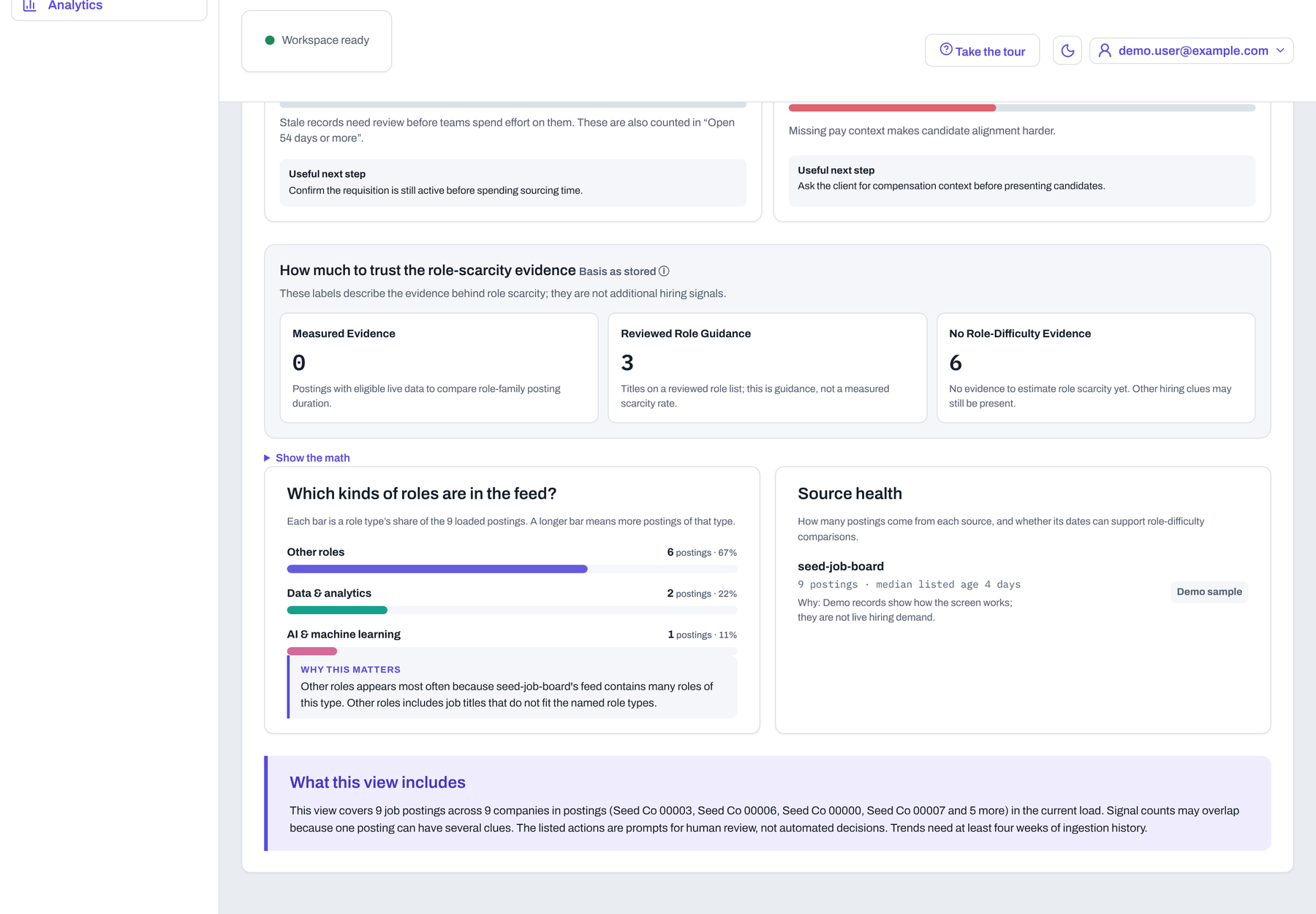
33 daysEach score now names its basis as measured, curated or none. Days open is still a proxy with survivorship bias, because the schema holds no close date, and the decision file says so.
- At Written in chunks of 100
Smaller writes, not a longer timeout
The first live ingestion fetched 1,036 real postings into the raw table and then wrote none of them: one bulk insert ran past the 5-second statement timeout, a size no test fixture had reached.
She found the cause by reading the code and rejected raising the timeout, because that one setting governs every query in the app. Writes were split into chunks of 200, then lowered to 100 two days later when a second run dropped one chunk.
Evidence Decision file 042 and commits on 29 and 31 Aug 2026.
0 of 1,036A batch no longer commits as one transaction, and the decision says so. A failed chunk is logged and the rest still land; a rerun is safe because each chunk upserts.
- At Match the employer
A decade-old contract is not 2026 hiring intent
Public employer records could show that a company can pay to fill a role, but only if a filing could be matched to the company and only if it was recent enough to mean anything.
Token-Jaccard similarity plus a small alias table, chosen over exact match, which gives no confidence value, and over a paid entity-resolution service, which was more than two real companies needed. She added a 24-month recency gate herself, so an old award still shows its date but contributes nothing.
Evidence Decision file 047 and the live run on 9 Sep 2026 that caught two bugs no mocked test could.
0 of 4On the two-company data the only matches were four federal awards from 2015 to 2017, so employer records added nothing. Whether they ever predict demand is untested.
- At React UI shows the reasons
A badge the data could not support was labeled as a guess
Ahead of a demo, the screens were restyled with Claude Code to match approved mockups. The mockup asked for a spread-potential badge and a top-pick star, and neither matched any field the backend had.
Simple client-side rules, labeled on screen as not a measured spread and logged as proposals pending the owner. A real spread needs bill and pay rates, which do not exist. The day count was parsed from the reason text, and the badge hides when the parse fails rather than guessing.
Evidence Decision files 048 and 054, commits from 15 to 30 Sep 2026, and the test fix on 3 Nov 2026.
17 testsA later restyle quietly removed each card's factor breakdown and weights version. 17 frontend tests failed; she restored the content and did not loosen the tests.
The build
- Decision log before the first feature
- First scored opportunity, every weight in one config
- Evidence that the spec held no weights
- The human release gate
- End-to-end tests and a CI gate
- Real postings from Greenhouse and Lever
- Reposts and days open computed over time
- Measured scarcity, Lever left out
- Employer records with a recency gate
- Two bugs only a real run could find
- The redesign begins, built with Claude Code
- Opportunities grouped by company
- The first hardness check
- The check corrected: insufficient data
- Provenance restored, one count everywhere
- The limits written into the README
Notes on 16 of the 16 steps
- Decision log before the first feature. The decision log template lands, then a walking skeleton of React, Express and Postgres on Docker Compose with health checks and correlation-id logging.
- First scored opportunity, every weight in one config. A posting becomes a scored opportunity with plain reasons. The weights are logged as decision 007, a proposal pending the owner.
- Evidence that the spec held no weights. A search of the full build guide, written up so the owner sees evidence rather than an assertion.
- The human release gate. Drafted packages gain draft and released states, a once-only release, and an append-only release audit. The same day, a rate limiter scoped to every route broke a demo and was narrowed to sign-in.
- End-to-end tests and a CI gate. A deterministic seed, end-to-end tests and a CI workflow that runs on every push.
- Real postings from Greenhouse and Lever. Public job boards replace the mock feed behind the same adapter, with raw rows saved before parsing. The first live run fetched 1,036 postings and wrote none; the writes were chunked the same day.
- Reposts and days open computed over time. A differ compares fetches to find reposts, days open and description churn, then is rewritten to compute absolute values after it failed CI.
- Measured scarcity, Lever left out. Role-family medians from Greenhouse only, with the keyword list as a labeled fallback and a three-state basis on every score.
- Employer records with a recency gate. H-1B, federal award and Form D sources, company matching and a 24-month gate. Wiring them in exposed that the measured-scarcity scorer had never been called on the live path.
- Two bugs only a real run could find. A records API rejected a sort on a field that was not requested, and a date printed as a full timestamp in the score's reasons.
- The redesign begins, built with Claude Code. The Opportunities screen becomes a card grid matched to an approved mockup, and the spread and top-pick rules are logged as proposals the same day.
- Opportunities grouped by company. One row per company on landing, clicking through to the filtered grid, so one employer no longer fills the screen.
- The first hardness check. A validation of the hardness score against observed time to close. This first run was later found to use later data and was superseded.
- The check corrected: insufficient data. Rebuilt so the score uses only what was visible at first sighting. The high group has 4 against a floor of 20, and no weights were changed.
- Provenance restored, one count everywhere. 17 failing frontend tests led back to cards that had lost their scoring breakdown, which was restored. A number audit then made every screen show the stored basis.
- The limits written into the README. The README gains the employer-record and Lever findings, and the builder's own narrative of the build lands beside it.
More from this project
Employer records on a real run: matched, and still no score changed
The builder's own chart of a real run on 9 Sep 2026 over 1,004 scored opportunities from two real companies. One company matched public federal award records; all of them were older than the 24-month recency window, so they contributed nothing to any score.
What was built
One local stack under Docker Compose: a React and Vite frontend, a Node and Express API, and PostgreSQL, with SQL migrations run on boot. There is no hosted demo and no public URL. Ingestion is two manual scripts, one for job postings and one for employer records, and nothing runs on a schedule.
Stack
- React 18
- TypeScript
- Vite
- Node.js
- Express
- PostgreSQL
- Docker compose
More on what was built
The parts, in the order a posting meets them. Providers for Greenhouse, Lever and the three record sources sit behind one adapter interface, beside mock and seed providers, so a real source replaces a mock without touching routes or scoring. Fetched rows are saved verbatim before parsing. A differ computes reposts and days open from the raw history. Company matching joins records to employers, and the scorers produce a confidence score and a hard-to-fill score from transparent weights held in config files. Scores are written in chunks of 100.
Every stored score carries its weights version and its basis, so a number on a card can be traced to the rule that made it. The UI shows the reasons first and the raw numbers behind a fold, and labels each source as live, fixture, or flagged and excluded.
The release gate is the one place a draft can become a decision. It is a conditional update that succeeds once, with an audit row; nothing is sent. Every outbound call goes through one wrapper with an explicit timeout, and logs are structured JSON with a correlation id. The screen redesign was built with Claude Code from approved mockups, and the frontend tests caught it dropping each card's scoring breakdown.
Capabilities
- Transparent version stamped scoring
- Human release gate with an audit row
- Raw storage before parsing
- Measured scarcity with a labeled fallback
- Company matching with a recency gate
- Source labels on every screen
Integrations
- Greenhouse public job boards read only
- Lever public job postings read only
- Public h 1b disclosure data
- Public federal award data
- Public sec form d data
Data stores
- PostgreSQL raw requisitions parsed and scored opportunities append only audit tables
The measurement
Fourteen figures, in two kinds. Eight were counted in the repository at the pinned commit and carry a verified badge. Six come from the builder's own runs against databases outside the repository and are labeled self-reported.
The headline is a shortfall on purpose. A scoring tool earns trust by saying when its own check cannot conclude, and this one says so: 4 of the 20 high-score requisitions it needs.
Nothing here measures use by a staffing team, a placement, or time-to-fill, because none of that happened. The app runs locally, by hand, on two real companies beside seeded rows.
Full notes on all 14 metrics
4 of the 20 high-score requisitions the check needs
High-score requisitions in the hardness check, against the minimum it declares
verified
- Baseline
- The floor the analysis declares before it will conclude anything: 20 requisitions in each score group.
- Sample
- 141 requisitions classified closed between 3 and 11 Sep 2026: 4 in the high group and 137 in the low group. Another 983 were still listed.
- Methodology
- Each requisition is scored from its first raw title and only the repost signal visible at first sighting, with days open left out so the score cannot contain the outcome it is tested against. A requisition counts as closed after more than two days missing from its feed. Both groups showed a median of 9 days, which carries no weight with 4 in the high group.
Limitations
- The high group is 16 short of the floor; the low group clears it.
- A posting dropping off a feed stands in for a filled role. It is not a confirmed placement or fill date.
- An earlier run dated 6 Oct 2026 reported 6 high and 135 low. It let a factor built from later days-open figures into the score, and the builder marked it superseded.
- The floor of 20 is a declared small-sample minimum, not a statistical power calculation.
24 of 54 decision records still marked proposed
Decision records still marked as a proposal awaiting the owner
verified
- Baseline
- Every decision file with a Decided by line: 54. One more file, 007b, is evidence for a decision rather than a decision.
- Sample
- All 55 numbered files in the decisions folder at commit c6ac0da.
- Methodology
- The first Decided by line of each file was read and matched for PROPOSED. Files that say pending, flagged for the owner, or confirmed by a stand-in instructor were counted as not proposed, so the figure is a floor on what is unsettled.
Limitations
- The proposals include every scoring weight: the confidence weights, the hard-to-fill weights, and the redesign's display rules.
- Two files share the number 051, which the builder notes in one of them; both are counted.
55 decision files
Decision files committed to the repository
verified
- Sample
- Every numbered markdown file in the decisions folder at commit c6ac0da, excluding its README.
- Methodology
- Listing the folder at the pinned commit. The numbering has gaps, such as 031, 033, 035, 052 and 053, and one number, 051, is used twice.
Limitations
- The first was committed on the first day of the build, 22 Jul 2026, before any feature code.
142 commits, 22 Jul to 11 Nov 2026
Commits from the first to the head of the default branch
verified
- Sample
- The full commit log to c6ac0da: first commit 22 Jul 2026, head 11 Nov 2026.
- Methodology
- Listing every commit reachable from the pinned head through the repository API.
Limitations
- Six of the 142 are merge commits.
- The last three commits, on 11 Nov 2026, remove project-management material from the repository; they change no code path or figure.
54 of 142 commits carry a Claude co-author trailer
Commits carrying a Claude co-author trailer
verified
- Sample
- All 142 commits to c6ac0da.
- Methodology
- Matching the trailer in each commit message. 44 name Claude Sonnet 5 and 10 name Claude Sonnet 5.5. The builder states that the screen redesign was done with Claude Code; the trailers also appear on scoring and ingestion work from 20 Aug 2026 onward.
Limitations
- None of the first 58 commits, from 22 Jul to 19 Aug 2026, carries the trailer.
- A commit made with an assistant but without the trailer would not be counted, so this is a floor.
114 frontend test definitions in 19 files
Frontend test definitions
verified
- Sample
- All 19 test files under the frontend source folder at commit c6ac0da.
- Methodology
- A text count of test definitions across the frontend test files.
Limitations
- These are the tests that caught the redesign dropping each card's scoring breakdown.
101 backend test files
Backend test files
verified
- Sample
- Every test file under the backend tests folder at commit c6ac0da.
- Methodology
- Listing the folder at the pinned commit. 28 of the 101 are named as integration or end-to-end tests.
Limitations
- The builder reports 468 backend tests passing on 3 Nov 2026 against a real Postgres. A text count of test definitions at the head finds 467, and that run was not repeated here.
- CI runs on every push.
0 of 13 runtime dependencies is a language-model client
Runtime dependencies that are a language-model client
verified
- Baseline
- The README states that no language model is called anywhere and that verdicts, packages and email drafts are fixed templates.
- Sample
- Nine backend and four frontend runtime dependencies at commit c6ac0da.
- Methodology
- Reading both dependency lists, then searching the backend and frontend source for model provider names. The only matches are comments saying no model is used.
Limitations
- The one outbound network wrapper in the backend sets a timeout on every call; the calls it makes go to the public job boards and record sources.
2 real companies in the ingestion config: GitLab and gopuff
Real companies the ingestion is configured to read
verified
- Sample
- The ingestion settings in the environment template at commit c6ac0da.
- Methodology
- Reading the two ingestion settings. The builder's decision files describe the same two companies as the whole real dataset.
Limitations
- Seeded and mock rows sit beside the real ones, with fictional company names that can never match a public record.
- Ingestion runs only when someone runs it by hand.
0 of 1,036 fetched postings written on the first live run
Fetched postings written on the first live ingestion run
anonymized
- Baseline
- All 1,036 postings, 220 from Greenhouse and 816 from Lever, were fetched and saved raw before the write failed.
- Sample
- The first live ingestion run, against the hosted database the project used at the time.
- Methodology
- As reported by the builder from the run's own error and row counts.
Limitations
- After chunking at 200, a second run lost one chunk to the same timeout and wrote 836 of 1,036; the chunk size went to 100.
- The raw rows survived both failures, which is what saving before parsing is for.
1,169 days median on Lever, against 33 on Greenhouse
Median days open on Lever postings, against Greenhouse in the same run
anonymized
- Baseline
- 33 days, the Greenhouse median in the same run.
- Sample
- One live run: 232 real Greenhouse rows from GitLab and 763 real Lever rows from gopuff.
- Methodology
- As reported by the builder. Days open is computed from the posting's own opened date against the latest fetch, because the schema holds no close date.
Limitations
- Days open is a proxy with survivorship bias: a role that filled quickly and dropped off before the next fetch is never counted.
- Lever is excluded from every measured median until its date field is understood.
0 of 4 matched federal awards counted toward a score
Matched employer records that counted toward a score
anonymized
- Baseline
- The 24-month recency gate the builder set: older evidence stays visible with its date but contributes nothing.
- Sample
- GitLab and gopuff, checked against federal awards for all time, and against one recent quarter each of H-1B disclosures and SEC Form D filings.
- Methodology
- As reported by the builder from a live run against the public sources. All four awards were GitLab's, dated 2015 to 2017. H-1B and Form D returned none for either company in the quarter checked.
Limitations
- One quarter of H-1B and Form D data is not full history, so a filing in another quarter would be missed.
- The claim that these records arrive before a posting is untested.
155 stored as measured, shown as 180 on three screens
Postings shown as measured basis, as stored against as re-derived in the browser
anonymized
- Baseline
- 180, the figure three screens showed after re-deriving the basis in the browser.
- Unit
- postings
- Sample
- 1,124 postings in the builder's local demo database on 3 Nov 2026.
- Methodology
- As reported by the builder. The gap is 25 Greenhouse rows scored before measured scarcity existed, which carry no stored basis; the browser re-classified them as measured.
Limitations
- Every screen now shows the stored value. The fix moved which number is displayed, not which is correct.
- 28 rows remain on the oldest weights; rescoring them is recommended and not done.
11 of 17 failing tests were lost provenance, not wording
Frontend tests failing after a restyle that were lost scoring provenance, not wording
anonymized
- Baseline
- 17 frontend tests failing after the restyle.
- Sample
- The failures fixed in one commit on 3 Nov 2026.
- Methodology
- As classified by the builder. The other six were stale wording assertions, which were updated.
Limitations
- The fix restored the content behind a Show the math section. The tests were not loosened.
What happened next
Shipped
- Raw postings saved before any parsing
- A weights version stamped on every stored score
- Human release gate with an audit row
- Measured role scarcity from Greenhouse, keyword list as fallback
- Employer-record signals behind a 24-month recency gate
- Opportunities grouped by company on landing
Unknown
- Settle the two known ranking issues
- Rescore the 28 rows still on the oldest weights
- Rerun the hardness check at 20 per group
- Scheduled ingestion
- A language-model explainer for the scores
Paused
- Resume parsing and a client-creation screen
Not pursued
- A hosted deployment
Notes on 13 of the 13 items
- Raw postings saved before any parsing. Every fetched posting is stored verbatim in a raw table first, so a parser mistake loses nothing.
- A weights version stamped on every stored score. An old score stays traceable to the weights that produced it after the weights change.
- Human release gate with an audit row. A drafted package can be released once, by a signed-in person. Releasing records the decision; there is no email integration.
- Measured role scarcity from Greenhouse, keyword list as fallback. A role family is measured only with at least 10 Greenhouse observations; everything else falls back to the curated list, and each score names its basis.
- Employer-record signals behind a 24-month recency gate. Built and wired into live scoring. On the two-company data the only matches were four federal awards from 2015 to 2017, so the contribution was zero.
- Opportunities grouped by company on landing. Shipped in the redesign and logged as a proposal, pending the owner.
- Settle the two known ranking issues. The top pick can land on a source the app marks flagged and excluded, and flagged rows still carry the hard-to-fill badge. Both touch ranking, so they wait on the owner. The builder lists this first for any further time.
- Rescore the 28 rows still on the oldest weights. Recommended in decision 051 so the stored and derived counts agree by construction. Not scheduled.
- Rerun the hardness check at 20 per group. Report a conclusion only once both score groups reach the declared floor. Not scheduled.
- Scheduled ingestion. Ingestion runs only when someone runs it by hand. Nothing polls on a schedule.
- A language-model explainer for the scores. A proposal only. No model is called anywhere today, and the README says any explainer would sit behind the same adapter seam and the same release rule, with its own decision file first.
- Resume parsing and a client-creation screen. Both deferred. Resume upload is a preview and files are not parsed.
- A hosted deployment. The project runs locally only. Decision files describe an earlier hosted deployment, which the README treats as project history.
Meet the builder
Megan Dimiyo-Mbenoun
Colaberry learner
Project contribution
Designed and built the application end to end: ingestion from the public Greenhouse and Lever job boards and three public employer-record sources, raw storage before parsing, longitudinal diffing for reposts and days open, the confidence and hard-to-fill scores with version-stamped weights, company matching with a recency gate, the human release gate, the validation analysis, and 55 decision files. She directed Claude Code for the screen redesign and other work, and 54 of the 142 commits carry a Claude co-author trailer.
Skills demonstrated
- Transparent scoringEvery confidence weight lives in one config object, and every stored score carries the weights version that produced it, such as hard-to-fill-026-v3.
- Human release controlReleasing a drafted package is a guarded, once-only database update with an audit row. Releasing records a decision; nothing is sent.
- Honest validationThe hardness check reports insufficient data at 4 of the 20 high-score requisitions it needs, and an earlier run that let later outcomes into the score was marked superseded by the builder herself.
- Data-quality judgmentLever postings showed a median of 1,169 days open against 33 on Greenhouse, so Lever was excluded from the measured medians instead of being published.
- Diagnosing real runsThe first live ingestion wrote none of 1,036 fetched postings; the cause was found in the code and fixed by chunking the writes.
- Directing an AI coding assistantAfter a Claude Code redesign, 17 frontend tests failed because the cards had lost their scoring breakdown. The content was restored and the tests were left as strict as they were.
From the repository record.
What this project shows
The lesson in this build is not the scoring. It is the discipline around it: a decision file for every business choice, a weights version on every score, a person at the release gate, and a validation that was allowed to come back inconclusive. 142 commits, 55 decision files, and the figure that matters most is 4, the high-score requisitions her check had when it needed 20.
Keep reading


Build one of these