
Training · learner work
The AI Recommends, a Person Admits
If you are thinking about Colaberry's AI internship, this is the path you would take: apply once, answer on a web form or to an AI interviewer, and a person reads it and decides. It is also a worked example of keeping a person in charge of what an AI does.
verified
All student projects- Organisation
- Colaberry
- Industry
- Education
- Capability
- An internship admissions pipeline where an AI recommends and a person decides
- Status
- Shipped
- Built by
- Ali Muwwakkil · Colaberry
- Published
- 2026-11-18
The situation
Colaberry's AI internship is unusual. It is full time and online, a new group starts every Monday, it runs until the intern lands a full-time AI role, and the intern pays a membership rather than receiving a stipend. Applicants have to be free to do it: nobody employed full time is eligible.
The intake did not match the program. Applicants emailed two staff inboxes with a fixed subject line and a commitment paragraph. The rules about plans, waivers and eligibility lived in one person's head, one outbound email and a sales document, and the teams that needed them each worked from a different partial copy.
The first attempt to model it in the platform got the money backwards, with fields for paying the intern. A literal build of the next specification had no payment step at all, so verifying an intern's documents would have handed over paid training for nothing. And the obvious way to let someone be both a learner and an intern, a second enrollment, collided with a platform built on one enrollment per person.
The team needed a path that one reviewer could run from a real admin surface, that let an AI do the interviewing without letting it decide, and that kept the money and the records straight.
What it had to do
- Replace email intake with one portal a reviewer can run.
- Let an AI interview at any hour while a person makes every admission decision.
- Give each intern one record from application to cohort, and support them on evidence rather than guesses.
What constrained it
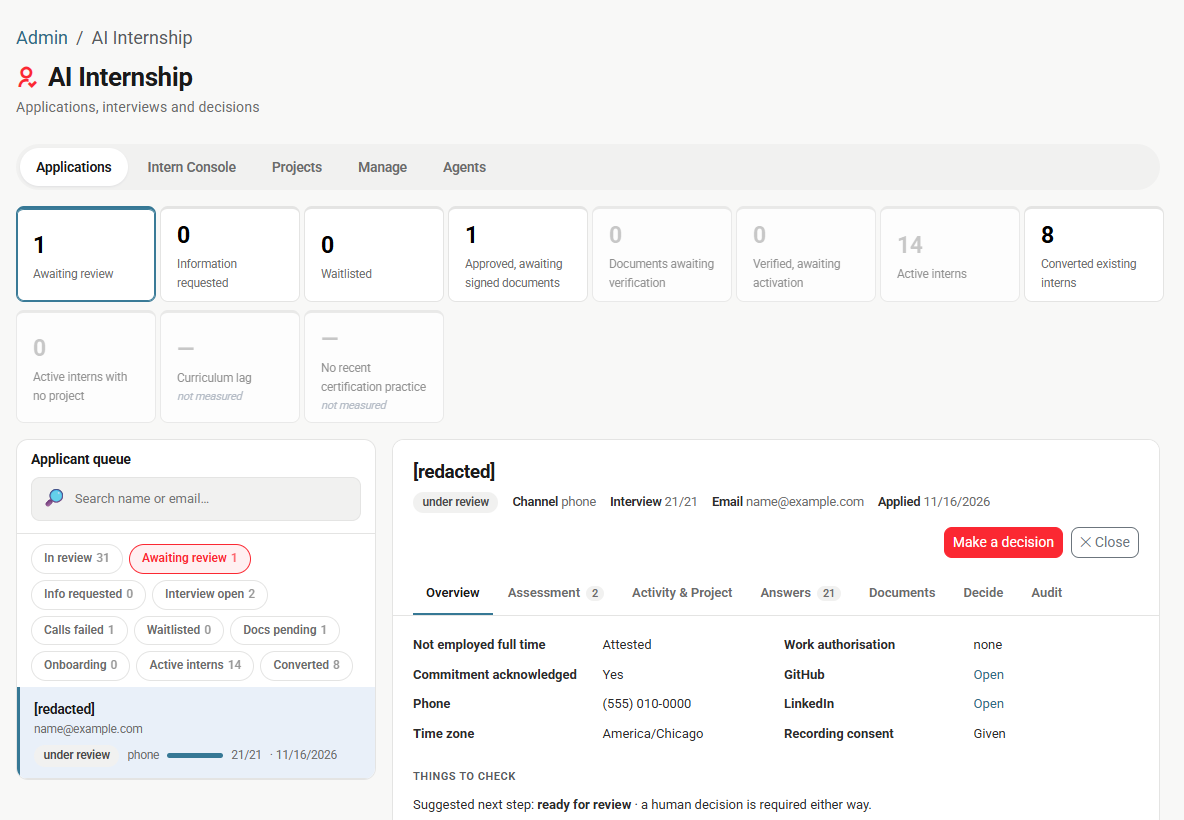
- Only a person may admit, reject or waitlist an applicant; no setting may let the system do it.
- An answer a model pulled from a phone call is never stored as if the applicant had typed it.
- An admitted intern must not receive paid training without the payment, a subscription, a comp or a deliberately free cohort.
- An intern keeps one enrollment; the internship must not create a second.
Decisions that made the difference
Five choices shaped the system. Each one lives at a specific point in the drawing above.
- At Reviewer decides
Only a reviewer can admit, and nothing overrides that
An admissions flow with an AI interviewer invites the obvious shortcut of letting the system approve the easy cases, and permission checks spread through route handlers are easy to get wrong silently.
Put every transition in one table that names which actor may take it. Approved, rejected and waitlisted belong to the reviewer alone, and the table takes no admin or force flag.
Evidence internshipStateMachine.ts and its test that no state lets the system or the applicant reach a decision (commit f0168b317); on live traffic 8 of 8 decisions were made by a reviewer.
9 SepEvery admission waits for a person, and the median from submission to decision is about four days. That is the cost of never having an applicant admitted or turned away by a machine.
- At Payment gate
Add the payment step the specification left out
The program charges a membership, but the specification's lifecycle went straight from verified documents to an active intern. Built as written, it would have given full paid training away.
Insert a payment state after document verification. A subscriber, an admin comp or a cohort marked free skips it, and a free internship stays possible only as one deliberate cohort setting.
Evidence The discovery report in docs/AI_INTERNSHIP_DISCOVERY.md, which rated the leak high risk, and the transition in internshipStateMachine.ts.
9 SepThe gate is proven by tests but has not yet fired on live traffic, because every intern so far was already paying or comped.
- At Cohort membership
An intern gets a membership, not a second enrollment
The first plan gave each intern a second enrollment. An audit found the platform's duplicate sweep would delete one, a comped intern would hit a paywall, and the portal would show a complete but wrong record with nothing logged.
Keep one enrollment per person and add a membership row to the internship cohort, with a database index that refuses a second active membership.
Evidence docs/INTERNSHIP_ENROLLMENT_AUDIT.md, internshipActivationService.ts (commit 6909b7218), and 0 duplicate memberships across 14 active interns.
9 SepEvery part of the platform that assumes one enrollment per person keeps working. Internship status lives in a second table that reports and tools have to join.
- At Applicant confirms answers
Never store a model's guess as the applicant's answer
An AI phone interview turns speech into answers, and an answer a model inferred, stored as if it were typed, is a fabricated statement attributed to a real person.
Store every answer extracted from a call as needing follow-up, and let only the applicant's own confirmation promote it. The reviewer sees requirement checks computed from confirmed answers, and an AI recommendation, never a score.
Evidence internshipTranscriptExtraction.ts and its tests (commit 305cb134a), and the Decide panel's deterministic checks (commit 4b7062055).
9 SepAn applicant who interviews by phone still has one more step before submitting. Of 17 phone answers on record, 11 have been confirmed this way.
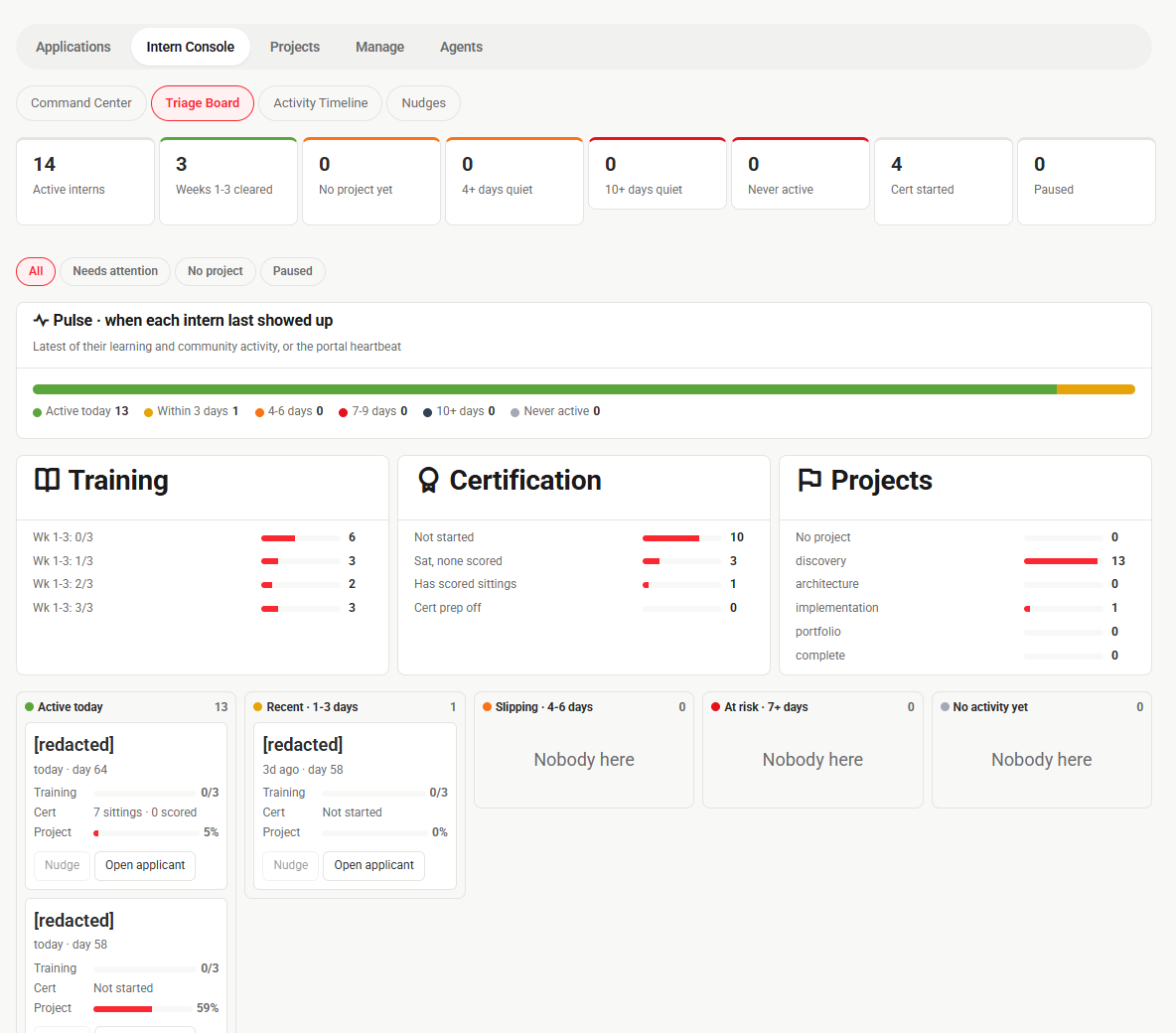
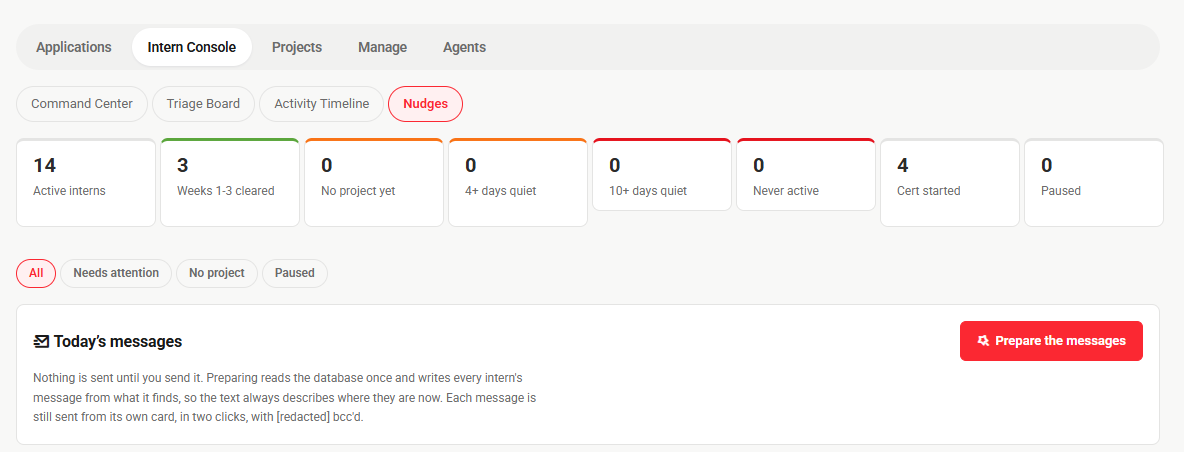
- At Intern console and nudges
Make dry runs and messages safe by construction
Moving existing interns onto the new path, and nudging interns who fall behind, are both one forgotten condition away from writing to live records or mailing a whole roster.
Split conversion into a plan that cannot write and a commit that takes the plan. Let managers nudge only with fixed templates sent to the roster, through a gate that refuses wording harder than the evidence supports.
Evidence internshipConversionService.ts with a test that spies on every writer (commit 0372ee6fb), the template nudge (commit 94c3a23be) and the escalation gate (commit b228f5719).
2 OctEight existing interns were moved across this way. Managers cannot write a personal note in a nudge, which is less flexible and is the point.
Who built it
- Ali Muwwakkil, Designed the pipeline and directed its build
- An AI coding assistant, named as co-author on 87 of the 94 commits
The build
- The lifecycle as a state machine
- One question bank, two channels
- Review queue and decisions
- The offer-letter package
- Activation and the internship cohort
- Tracking and moving existing interns
- A phone interview that finishes on its own
- AI assessment on the Decide panel
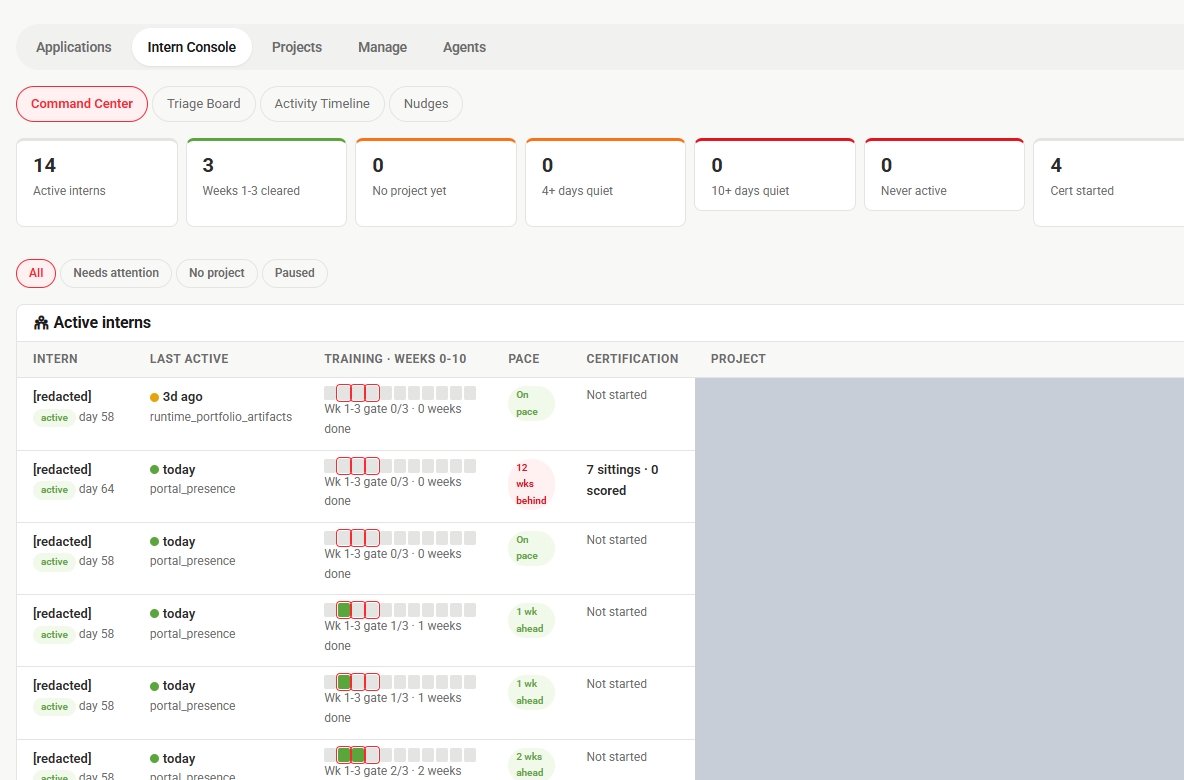
- The intern console and template nudges
- An escalation gate held to the evidence
Notes on 10 of the 10 steps
- The lifecycle as a state machine. Twenty-two states, three actors, admission reserved for the reviewer, and a payment gate the specification lacked.
- One question bank, two channels. Web form and AI phone interview read the same bank; extracted answers wait for the applicant.
- Review queue and decisions. Closed reason codes and decision mail that cannot be sent twice.
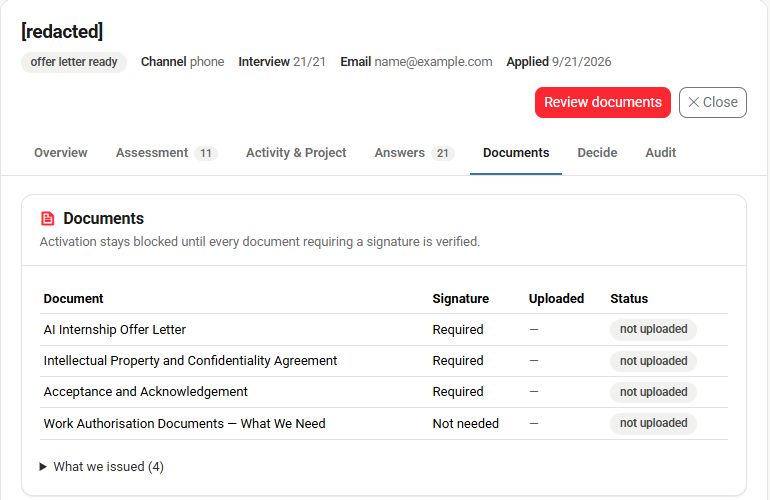
- The offer-letter package. Documents with a printed ID, a template version and a stored checksum.
- Activation and the internship cohort. One membership per intern instead of a second enrollment.
- Tracking and moving existing interns. A conversion dry run with no write in it; unknown reported as unknown.
- A phone interview that finishes on its own. A live call left a session stuck; results are now read from the provider when the webhook is missing.
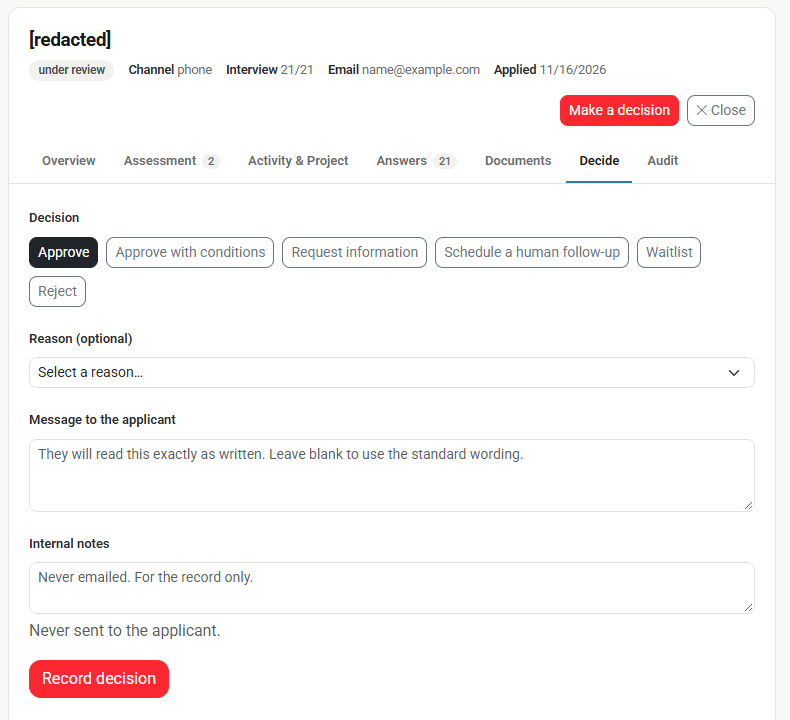
- AI assessment on the Decide panel. Deterministic requirement checks beside an AI recommendation; approvals need no reason.
- The intern console and template nudges. One admin surface per intern, and nudges from a fixed template set.
- An escalation gate held to the evidence. Two holes found on the live roster closed: no message harder than the evidence supports.
What was built
Every application moves through a state machine of 22 states and three actors: the applicant, the reviewer and the system. One function writes state, and the transition table decides who may take each step. Admission edges belong to the reviewer alone, and the table has no override flag, because an override is eventually passed by a caller in a hurry.
Stack
- TypeScript
- Node.js
- PostgreSQL
- Sequelize
- OpenAI API
- Synthflow voice agent
More on what was built
The applicant starts by recording consents, then answers one versioned question bank either on a web form or by asking the AI to call them. The call is handed only the questions still unanswered. When it ends, its answers are extracted from the transcript but stored as needing follow-up; the applicant reviews and corrects them before submitting. If the call's completion message never arrives, a reconciler reads the result from the voice provider instead.
On the reviewer's Decide panel, requirement checks computed directly from the answers sit beside an AI summary that treats the applicant's text as untrusted and offers a recommendation, never a score. The reviewer decides with a reason from a closed list, and the decision email carries a key that stops it being sent twice.
An approval generates the offer documents, each with its ID and template version printed on the page and a checksum stored. A reviewer verifies the signed copies, and a payment gate then sends the intern to payment or, for a subscriber, a comp or a free cohort, straight to activation. Activation adds one membership to the internship cohort and leaves the enrollment alone. From there the intern console tracks training, projects and certification, reporting unknown as unknown, and managers nudge interns only through fixed templates checked against the evidence.
Capabilities
- Human in the loop decisions
- AI voice interviews
- Workflow state machine
- Document integrity
- Evidence bound nudges
Integrations
- Synthflow for the AI phone interview with a reconciler that reads results from its API
- OpenAI API for transcript extraction and the applicant summary
- Email through a deduplicating send ledger
- A meeting provider for the cohorts standing rooms
Data stores
- PostgreSQL applications status events interview sessions and answers decisions documents cohort memberships attendance
The measurement
Some figures are counted from the public repository at a pinned commit, and anyone can recount them. The rest were read from the platform's database on 18 November 2026 and are published as platform measurements. Staff accounts that went through the flow are counted in, and each figure notes where they appear.
The headline checks the rule the whole design rests on: of 8 admission decisions on live traffic, all 8 were made by a reviewer. The record also keeps the AI's recommendation next to each decision, so it shows the reviewer approving 2 of the 3 applicants the AI flagged for a closer look.
The figures are honest about scale. Eight decisions and one completed AI phone interview are too few to quote as rates. Twenty-seven applications have not gone past the first step, and no intern was activated in November. Nothing in the platform records whether an intern was hired.
8 of 8 admission decisions made by a reviewer
Admission decisions made by a reviewer, not the system
verified
- Baseline
- None. The rule holds by construction, so this checks it on live traffic rather than measuring a change.
- Sample
- Every status change recorded for the 48 internship applications, read on 18 Nov 2026 (05:10 UTC).
- Methodology
- Count of internship_status_events whose new state is an admission decision, grouped by actor type. All 8 were made by the reviewer actor (7 approvals, 1 rejection); 0 were made by the system actor. The whole log holds 342 events: applicant 282, reviewer 53, system 7.
Limitations
- Eight decisions is a small sample; it shows the rule holding, not how it behaves at volume.
- Two of the eight decisions concern staff accounts on the company domain that went through the flow.
- The state machine makes any other result impossible, so this confirms the code, it does not test the reviewer's judgement.
2 of 3 AI-flagged applicants approved by the reviewer
Applicants the AI flagged for follow-up whom a reviewer still approved
verified
- Baseline
- The AI reading on each application: ready for review on 5, human follow-up suggested on 3.
- Sample
- The 8 internship decisions on record, read on 18 Nov 2026 (05:10 UTC).
- Methodology
- Every decision row stores the AI recommendation it was made beside. The 5 marked ready for review were all approved. Of the 3 marked for follow-up, the reviewer approved 2 and rejected 1, for an incomplete application.
Limitations
- Three cases is far too few to describe how often reviewers overrule the AI; this shows that they can and do.
- The AI reading is a recommendation by design, so a difference is not an error by either side.
42 of 42 signed documents verified
Signed internship documents verified by a reviewer
verified
- Baseline
- Before the portal, offer paperwork travelled by email, with no record of which version a person signed.
- Sample
- Signed uploads in internship_documents, read on 18 Nov 2026 (05:10 UTC).
- Methodology
- Count by document kind and status: 42 signed uploads, three documents for each of 14 applications, all verified, none past revision 1. The 22 generated documents each carry a printed document ID and a stored checksum.
Limitations
- Verification is a reviewer's check that the right document came back signed, not a legal review.
- Two of the 14 applications belong to staff accounts.
0 duplicate memberships across 14 active interns
Duplicate active internship memberships
verified
- Baseline
- The audit found that a second enrollment per intern would be removed by the platform's duplicate sweep.
- Unit
- duplicates
- Sample
- Active memberships in the one ai_internship cohort, read on 18 Nov 2026 (05:10 UTC).
- Methodology
- Grouped count over cohort_memberships for the internship cohort. A unique partial index makes a second active row impossible, so this confirms the constraint on live data. All 14 active interns hold one active, paid enrollment.
Limitations
- The database constraint guarantees this result; it shows the design is in place, not that it was tested under pressure.
35 of 48 modules have a test file
Internship modules with a test file of the same name
verified
- Baseline
- None. This sizes the test surface rather than comparing it.
- Sample
- The 48 top-level modules in backend/src/services/internship at commit 59720e20f.
- Methodology
- Match each module to a test of its own name. Thirteen have none, among them the decision and document services; some of those are exercised by tests named for something else. The folder holds 64 test files in all, including the nudge brief and nightly report subfolders.
Limitations
- A test file named after a module may test little of it; this counts files, not coverage.
- The decision and document services, central to the flow, have no test of their own name.
94 commits, 9 Sep to 14 Nov 2026
Commits that built the internship module
verified
- Baseline
- None. This sizes the build.
- Sample
- Every commit touching backend/src/services/internship up to 59720e20f.
- Methodology
- git log over the folder. All seven phases of the original build landed on 9 Sep 2026; the rest is the console, nudges, the nightly report and fixes found on live traffic.
Limitations
- A commit count says nothing about the size of each change.
- Admin and portal pages live in the frontend folders and are not counted.
87 of 94 commits name an AI coding assistant as co-author
Commits naming an AI coding assistant as co-author
verified
- Baseline
- None.
- Sample
- All 94 commits in the folder's history.
- Methodology
- Read from the public repository by commit message.
Limitations
- A trailer records that an assistant was involved, not how the work was divided.
What happened next
Shipped
- Application to cohort, one portal
- AI phone interview
- Payment gate
In progress
- Find out why applications stall
Unknown
- Record whether an intern was hired
Notes on 5 of the 5 items
- Application to cohort, one portal. 48 applications, 8 decisions and 14 active interns on 18 Nov 2026 (05:10 UTC).
- AI phone interview. Live, with one completed call so far against two failed and one cancelled; most applicants choose the web form.
- Payment gate. Proven by tests; no live application has needed it yet, because every intern so far was already a subscriber or comped.
- Find out why applications stall. Twenty-seven applications sit at the first step with a median age of 20 days, and nothing records why.
- Record whether an intern was hired. The program runs until an intern lands a full-time role, but no state or field records that outcome, so placement cannot be measured.
Meet the builder
Ali Muwwakkil
Managing Director & AI Systems Architect, Colaberry
Project contribution
Designed and directed the build of the internship pipeline in the platform: the state machine, the two-channel interview, the reviewer's Decide panel, the document package, the payment gate, cohort membership and the intern console, with each phase shipped behind its own tests and fixes taken from live traffic.
Skills demonstrated
- Keeping the decision with a personAdmission edges belong to the reviewer in the transition table, with no override.
- Using AI without trusting its guessesExtracted phone answers wait for the applicant; the AI recommends, never scores.
- Reading the money correctlyA payment gate the specification lacked, so verification cannot give away paid training.
- Fitting a new program into an existing platformOne membership instead of a second enrollment, after an audit of what a second would break.
- Reporting what is not knownUnknown is not zero in tracking, and nudges cannot exceed the evidence.
Career facts as confirmed to Colaberry; project contribution from the repository record.
What this project shows
For a learner, two things are worth taking from this build. The first is how the internship works: the AI interviews and reads, a person admits, and your progress is tracked on what you do, not on what you report. The second is a pattern you can reuse in your own projects: let the AI do the work that grows with volume, and write the rule that keeps the decision with a person into the code, where no setting can change it. The record is honest that it cannot yet show who was hired.
Keep reading


Build one of these